Understanding a Birth Chart: The Basic Building Blocks
Quick Answer
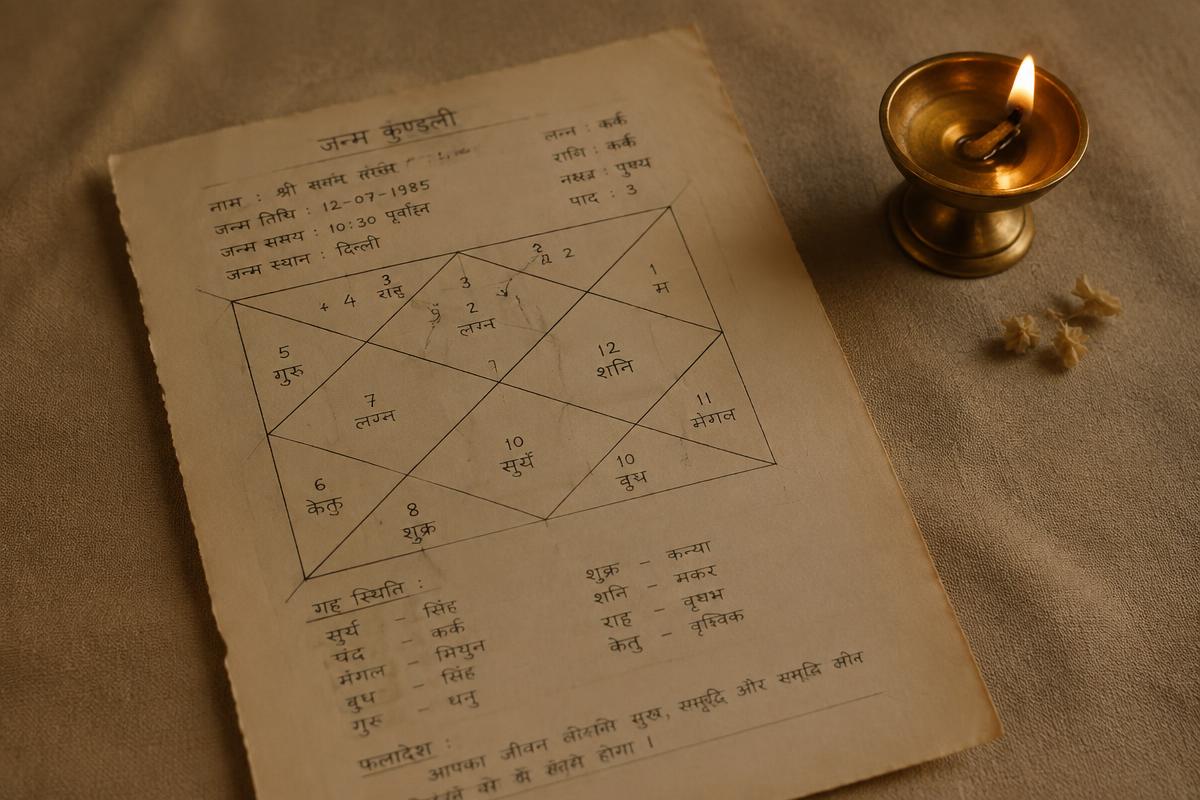
A birth chart, or kundli, is a diagram of planetary positions at the date, time and place of a person's birth. In Vedic astrology it is divided into twelve houses and signs. Astrologers interpret it as a traditional, symbolic framework for reflection — not as a deterministic prediction of events.
A birth chart can look complex at first. This article introduces its main building blocks so that a consultation conversation feels more familiar.
The core components
- Lagna (Ascendant)
- The sign rising on the eastern horizon at birth; it anchors the house structure of the chart.
- Houses (Bhavas)
- Twelve divisions, each traditionally associated with areas of life such as home, work or relationships.
- Grahas
- The planets and nodes used in Vedic astrology, each with traditional significations.
- Dashas
- Traditional planetary periods used when discussing timing.
Why birth details matter
Because the ascendant changes roughly every two hours, the birth time affects the house structure. Place of birth is needed to calculate local time and position.
Astrology is a traditional interpretive practice. It should not be used as a substitute for medical, financial, legal or other professional advice.
Key Takeaways
- A birth chart maps planetary positions at birth.
- The ascendant, houses, grahas and dashas are its core elements.
- Accurate birth time and place matter.
- Charts are a lens for reflection, not fixed forecasts.